lunes, 15 de mayo de 2017

Stratfor - How Venezuela's Protests Are Different This Time Around

https://gallery.mailchimp.com/74786417f9554984d314d06bd/images/8627f8b0-b063-4e98-90b8-e0377c04ffeb.png                                                                            May 12, 2017 | 19:04 GMT


How Venezuela's Protests Are Different This Time Around

Protesters help a demonstrator who was run over by a National Guard vehicle during a protest against Venezuelan President Nicolas Maduro, whose government is desperately clinging to power.
(FEDERICO PARRA/AFP/Getty Images)

It can be difficult to separate the important from unimportant on any given day. Reflections mean to do exactly that — by thinking about what happened today, we can consider what might happen tomorrow.

For nearly five weeks, Venezuela's political opposition has organized thousands of people to protest almost every day. All major cities have experienced formal protests organized by the opposition and destructive bouts of looting by hungry citizens. Unlike the protests in 2014, which were led by a relatively small faction of opposition parties, these demonstrations have maintained their momentum despite several weeks of violent government crackdowns. The frequency of violent confrontations between protesters and security forces suggest that the demonstrations will not quietly taper off, even though each day the government has managed to disperse the protesters. Venezuela's protests have passed the point of no return, though their final outcome depends on actions by the protesters, the government and, most importantly, the armed forces.

Support for the Venezuelan government has steadily eroded under two years of severe economic crisis. Polls and anecdotal evidence suggest that only a third of the population would support the ruling party in an election. Complicating the government's position is the fact that the ruling United Socialist Party of Venezuela (PSUV) is split. Attorney General Luisa Ortega is openly defying its leadership over decisions taken to quell protests, but President Nicolas Maduro has been unable to remove her from her post because she enjoys the support of key factions of the government and armed forces.

Desperate Governments Do Desperate Things

Faced with the possibility of losing power in an electoral contest, and with party officials facing the risk of imprisonment or extradition, the government has begun trying to bolster its position in case it has to hold elections. The increasingly divided ruling party is attempting to limit the number of parties that can run against it as it moves to rewrite the constitution and build a new militia. However, popular anger from the middle class and increasingly from the country's lower classes is boiling over in the streets. Years of food and medicine shortages as well as high inflation mean the government will struggle just to contain large-scale daily demonstrations, much less win elections. And there is no relief in sight: Oil revenue in the country will likely be stagnant for years because of long-term economic mismanagement, and runaway inflation will continue. Even if current protests fade, they will act as a catalyst for future demonstrations. 

Though it is unclear how protests will progress, it is obvious that the current situation is unsustainable. Protests have not dissipated, despite daily crackdowns by the National Guard and by the Bolivarian National Police. The state is devoting a significant amount of resources — money and security personnel — to maintaining public order in Caracas and in other cities. But still, demonstrations have repeatedly shut down the Caracas mass transit system and major thoroughfares. Bouts of looting have increasingly broken out in Valencia and in the poorer neighborhoods of western Caracas. And it's not just civilians protesting. The General Directorate of Military Counterintelligence has been arresting dissenters — even passive ones — in the military's ranks to ward off the threat of a coup. Stratfor sources claim that members of the military have complained about worsening work conditions and have been jailed by military counterintelligence agents. However, the military counterintelligence apparatus is spread thin and is limited in its ability to crack down on internal dissent. Still, rumblings of military dissent are of crucial concern: Efforts to stop protests from crumbling the government will prove futile if parts of the army support them.

Look for Repression To Increase

As protests intensify, so too will the government repression of them. Protesters have not been able to overwhelm the National Guard or police, but neither have they been deterred by their presence. This could prompt the government to turn to more violent methods of repression, especially as protests also become more violent. Cities in Venezuela's Andean region, such as Valencia, Merida and San Cristobal, have experienced frequent violent protests and looting, as well as violence against security forces. But if the president deploys the armed forces against demonstrators, it could prompt Washington to enact more sanctions against he country. There is also the risk that members of the military could defect if they are tasked to use force to bolster such an unpopular government. For these reasons, while Maduro is hesitant to rely on the armed forces, it does not mean that he won't.

The Maduro government has tried to offer political solutions to its opponents, such as creating a way for citizens to help rewrite the constitution. But opposition forces are unlikely to negotiate, given how unproductive government-sponsored talks last yearwere. As its options dwindle, the Maduro government is more likely to turn to violence. Whether it can do so without alienating important members of the armed forces is an open question.

There is clearly enough momentum for protests to persist. Demonstrators are showing very little fear of security forces and return to the same protest sites after being dispersed the day before. Even if the government manages to slow protests, it will likely only be buying itself a bit of time rather than solving its problems permanently. The longer that waves of protest keep pressuring the government, the more likely a severe split within the government and the security forces will become — which will risk ending Maduro's term early.

Todos 'A la Lucha' por Venezuela


domingo, 9 de abril de 2017

Venezuela - Don't be fooled by the ‘fake news’ published by TeleSur

April 9, 2017

Don't be fooled by the ‘fake news’ published by TeleSur

Venezuelan regimen spreads 'fake news' to cover up the use of toxic chemical warfare against peaceful protesters. TeleSur is a satellite television network sponsored by the governments of Venezuela, Cuba, Ecuador, Nicaragua, Uruguay, and Bolivia that is headquartered in Caracas, Venezuela.


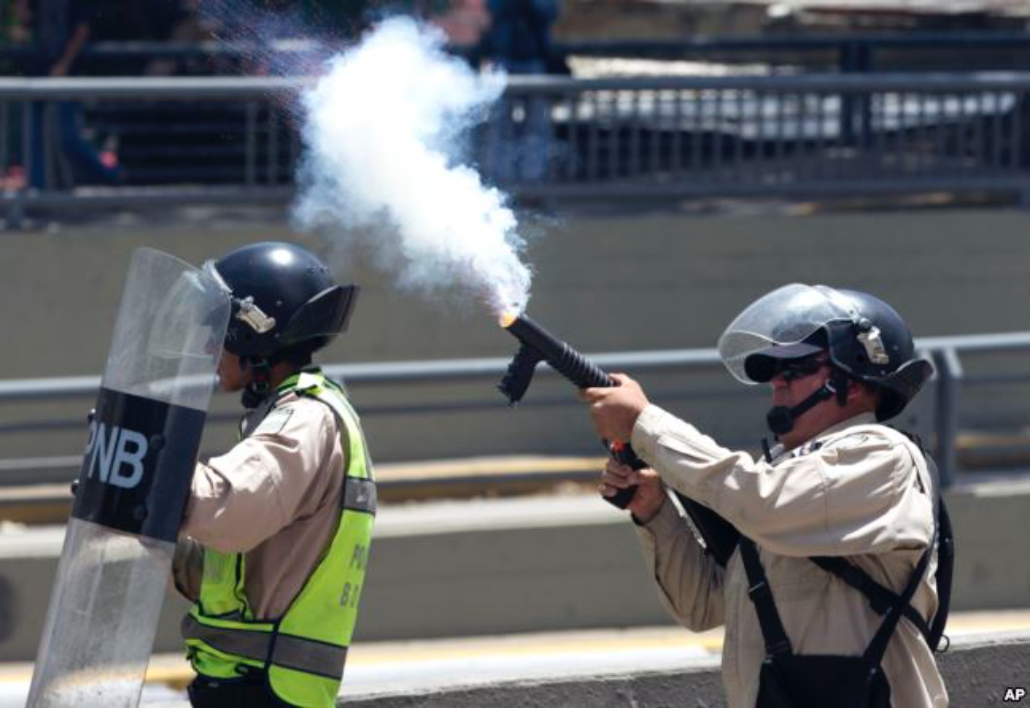
The fact is that Maduro's Bolivarian Guard indeed used illegal expired dangerous “toxic chemical weapons in the form of tear gas and unknown pink gas against Venezuelan civilians in anti-régime protests in Venezuela. 


The tear gas fired to the protesters expired on October 2015 and had a very strong and toxic effects on the protesters. 


The Castro-communist Maduro's regime uses this of type of chemical warfare to control, disperse and shut down pacific anti-Maduro demonstrations in violation of the freedom of expression and the right to protest as established in the Constitution of the Bolivarian Republic of Venezuela under Articles 5*, 333** and 350***. One person was killed, 164 people arrested during the anti-government protests this week, 74 of which remain behind bars. 


Venezuela's regime continues to spread its “fake news” through its networks, all while limiting the opposition's access to three digital TV stations, VPI TV, Vivo Play and Capitolio TV portals, and other Internet TV channels by censuring and declaring them illegal. 


This censorship was imposed and executed without guarantee of due process, a constitutional right, since there was not an express order on behalf of the State or the digital TV operators, as denounced by Venezuela Inteligente and IPYS Venezuela.

Venezuelan activists are committed to uncover and denounce "fake news" fabricated by the Maduro's regime and its allies.  


*Article 5: Sovereignty resides untransferable in the people, who exercise it directly in the manner provided for in this Constitution and in the law, and indirectly, by suffrage, through the organs exercising Public Power. The organs of the State emanate from and are subject to the sovereignty of the people.

**Article 333: This Constitution shall not cease to be in effect if it ceases to be observed due to acts of force or because or repeal in any manner other than as provided for herein. In such eventuality, every citizen*, whether or not vested with official authority, has a duty to assist in bringing it back into actual effect.

*** Article 350: The people of Venezuela, true to their republican tradition and their struggle for independence, peace and freedom, shall disown any regime, legislation or authority that violates democratic values, principles and guarantees or encroaches upon human rights.


#VzlaEnLuchaYResistencia #FakeNews #Venezuela #ResistenciaNoviolenta #DeLaDictaduraALaDemocracia #desafío político #DesobedienciaCivil #ElPoderDeLaGente #resistencia #noviolenta #ElPoderDeLaResistenciaCivilNoviolenta #Libertad  #Democracia #Justicia 

Cristal Montañéz
cristalmontanezvenezuela@gmail.com
@cristalmontane

sábado, 8 de abril de 2017

Maduro’s regimen attacks Venezuelan opposition with unknown toxic ‘pink-reddish’ gas

Venezuela’s regimen uses chemical weapons against protesters

Saturday, April 8, 2017.- Thousands of Venezuelan took the streets in Caracas and cities across the country in a march to demand the restitution of the constitutional thread, election chronogram, and dismissal of the judges of the Constitutional Chamber of the Supreme Court of Justice, among other petitions. Vice-president Tarek El Aissami declared the march ‘illegal and anti-constitutional.’ Recently, El Aissami was sanction by the Trump administration for promoting international terrorism.


Venezuela’s national guard responded to the pacific anti-Maduro march with expired tear gas (October 2015), and an unknown stronger and more toxic pink-reddish gas. This fact was denounced by Dr. Jose Manuel Olivares, a Deputy to the Venezuelan National Assembly on his Twitter account.


We must continue to alert and denounce before the international community the use of chemical weapons for civilian population control in Venezuela.


#                       #                      #

cristalmontanezvenezuela@gmail.com
@cristalmontane


jueves, 6 de abril de 2017

sábado, 22 de octubre de 2016

Por qué declararnos en Desobediencia Civil? - El Poder de la Resistencia Civil Noviolenta


Nos declaramos en Desobediencia Civil


Porque la Desobediencia Civil es un derecho ciudadano amparado por la Constitución Nacional. 

Porque la Desobediencia Civil es una forma de protesta intrínsecamente democrática. 

Porque la Desobediencia Civil es una decisión basada en nuestra determinación de negarnos a cooperar con el régimen.

Porque la Desobediencia Civil es un arma ‘noviolenta’ que los demócratas podemos usar contra el régimen opresor y violento. 

Porque, somos mayoría y no tenemos miedo, y el régimen no podrá gobernar si nos negamos a obedecer. 

Nos declaramos en Desobediencia Civil porque, la Constitución Nacional establece que la soberanía reside intransferiblemente en nosotros ‘el pueblo’, y nosotros desconocemos el régimen Castro comunista de Nicolás Maduro, su legislación y autoridad por contrariar todos los valores, principios y garantías democráticas y violar los derechos humanos de los venezolanos Art 350. 

#Venezuela #resistencianoviolenta #desafio #DesobedienciaCivil #ElPoderDeLaGente #resistencia #noviolenta #GeneSharp #CristalMontanez #DeLaDictaduraALaDemocracia #ElPoderDeLaResistenciaCivilNoviolenta #Libertad #Democracia #Justicia #Autoconvocados